
Current Projects
Records of Refuge: Supporting Refugee Communities’ Archival Needs
Records of Refuge is a multi-pronged archival and information science initiative seeking to meet the information and documentation needs of refugees. Informed by our experiences and training as archival and information scholars who belong to refugee, immigrant, and US-born communities, we hope to use this project to rectify a relative lack of LIS literature on the documentation-related information needs of refugees and a relative lack of refugee voices in LIS spaces. In doing so, we seek to work with refugees while centering their voices and agency in our research into how information challenges affect refugee’ documentary burdens, how information challenges are mitigated, and how the LIS field can help meet the information needs of refugees and refugee service workers.
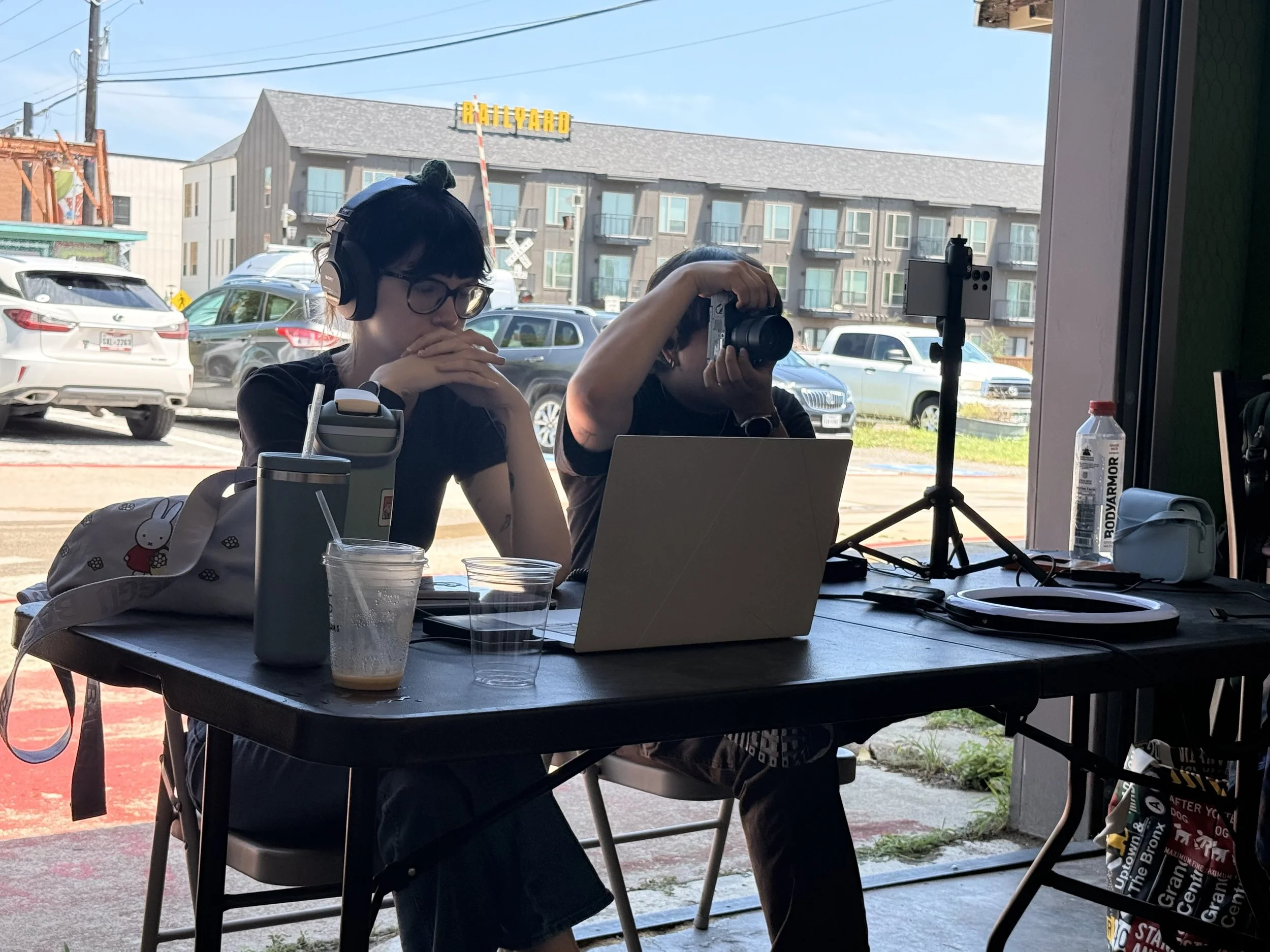
A key aspect of this work is Our Refugee Stories Archives (ORSA), a community-based archival resource that is open to all refugees in the United States. ORSA is a growing community archive, education initiative, and research collective. Drawing on models of radical hospitality in archival contexts, we are building ORSA Academy, a freely available, scenario-based curriculum adapted from interdisciplinary archival education models to teach personal digital archiving, community collection building, and the safe use of AI for vital information seeking.
Mapping Information Austerity
Democratic life depends on an information infrastructure that allows people to access accurate information, evaluate evidence, and participate meaningfully in public life. That infrastructure is under sustained pressure. Through a program of research on information austerity, this project investigates the conditions under which equitable access to information is systematically eroded, and what information professionals, memory workers, educators, and communities can do in response.
Information austerity arises from the convergence of three reinforcing governance failures: fiscal austerity that defunds public institutions like libraries and eliminates information professionals; deregulation that allows platforms to profit from misinformation without accountability; and ideological governance that restricts what information communities can access on partisan grounds. Together, these forces produce an engineered scarcity that, as with most austerity, distributes its costs most harshly onto communities already underserved by information institutions. This research examines how information austerity manifests across local, national, and global contexts; how it shapes the information-seeking experiences of marginalized populations, including of displaced people; and how it intersects with the proliferation of AI-generated content and algorithmic misinformation.
Archival Literacy as a Core Competency: Interrogating the Place of Archives in Information Education
Most archivists in the United States receive their professional training through ALA-accredited master’s programs, where they study the foundations of librarianship alongside archival practice. But does this exchange work in both directions? Are future librarians and information professionals introduced to foundational archival concepts, or are archives positioned as a specialization outside the knowledge every information professional is expected to share? Our initial analysis of the required curricula at 53 ALA-accredited programs that offer archival studies electives, found that fewer than half include archival content in their core courses. Only about one in five require all students to engage substantively with archival ideas.
This project expands that research to the global iSchool network. Through syllabus analysis and a multilingual survey of core-course instructors, we are examining how accreditation systems, national disciplinary traditions, and institutional structures shape the place of archival knowledge in information education. Alongside this research, we are developing an openly licensed teaching toolkit to help programs incorporate archival perspectives into existing core courses without adding credit hours. The toolkit will include model modules, assignments, assessment rubrics, and reading lists designed to make archival concepts a more visible and integral part of information-professional education.
Selected Publications
Roeschley, A., Rocca, S., Khader, D., Klein, K., Frederick, M., Brown, N., Braga, D., Rendon Cuevas, H., Afemon, B., & Alizai, K. (In Press). Googling Bobby Sands: Information Austerity and the Collapse of the Library and Information Science Age. The Library Quarterly.
Roeschley, A., Alizai, K., Tharayil, C., Lanier, A., Frederick, M. D., & Cuevas, H. R. (2026). An archival responsibility: A scoping review of literature regarding the documentary burdens of refugees. Journal of Contemporary Archival Studies, 13(1). https://elischolar.library.yale.edu/jcas/vol13/iss1/5
Christian-Lamb, C., & Roeschley, A. (2026). One degree, two disciplines? Examining the presence of archival concepts in American Library Association accredited core courses. Information Research an International Electronic Journal, 31(iConf), 540–546. https://doi.org/10.47989/ir31iConf64286
Brown, N., & Roeschley, A. (2026). Archival collections for the people? Using survey experiments to understand public opinions regarding archival services. Reference Services Review, 54(2). 121–138. https://doi.org/10.1108/RSR-08-2025-0062
Christian-Lamb, C., Roeschley, A., Saurombe, N., Mojapelo, M., Chaterera-Zambuko, F., Erima, J., & Tognoli, N. (2026). What We Can Learn From Each Other: International Archival Pedagogy Conversations and Collaborations. Archival Pedagogies, 263-284.
Khader, D. (2025). Cultivating lost gardens. Antennae, (67), 38-49. https://www.antennae.org.uk/
Frederick, M., Roeschley, A., & Zavalina, O. L. (2025). Beyond language archives: Proposing the archival community informatics framework as an interdisciplinary link to revitalization lexicography. Information Research an International Electronic Journal, 30(iConf), 1169–1179. https://doi.org/10.47989/ir30iConf46942
Roeschley, A., Miller, J., Nikitopoulos, A., Gieringer, M.D., & Holden, J. (2024). Archiving difficult realities: A systematic investigation of records related to sexual violence in U.S. college and university archives. Archival Science.https://doi.org/10.1007/s10502-024-09434-0
Kim, J.,Roeschley, A., & Byun, M.(2024). Building bridges, preserving voices: Key factors in community oral history stewardship. Journal of Documentation.https://doi.org/10.1108/JD-11-2023-0247
Roeschley, A.(2023). Symbiosis or friction: Understanding participant motivations for information sharing and institutional goals in participatory archive initiatives. Journal of Librarianship and Information Science.https://doi.org/10.1177/09610006231154912
Roeschley, A. (2023). “They care enough to document people's stories”: Using ethnographic methods to understand collection day outreach events in participatory archives. Library and Information Science Research, 45(2). https://doi.org/10.1016/j.lisr.2023.101234
Holden, J. & Roeschley, A. (2020). Privacy and Access in the Massachusetts Society for the Prevention of Cruelty to Children Records. The American Archivist, 83(1), 77-90. https://doi.org/10.17723/0360-9081-83.1.77
Roeschley, A. & Kim, J. (2019). “Something that feels like a community”: The role of personal stories in building community-based participatory archives. Archival Science, 19(1), 27-49. https://doi:10.1007/s10502-019-09302-2